

Gift Deed in Pakistan: Hiba, Fees, Taxes & Transfer Procedure
-
Written by:
 Icons Team
 - Last updated: September 6, 2026
- Howto-guides

A gift transfer is a voluntary transfer of property from one person to another without receiving money or other consideration. For Muslims, Hiba means giving property as a gift.
In Pakistan, a person can use Hiba to transfer a house, plot, land or other property to a family member during their lifetime. For example, a father can gift property to his son or daughter, or a person can gift property to a spouse or parent.
For a Hiba to be valid, it generally requires declaration, acceptance, and delivery of possession. The transfer must also comply with the applicable registration, transfer, and land-record requirements.
Where do you process a gift transfer? It depends on the authority that holds or records the property.
In my 10+ years of experience as a property transfer officer, I’ve seen many people make mistakes by preparing the wrong documents. The key is to identify the office first, then prepare its required documents.
| Office / Government Authority | Common requirements |
|---|---|
| Revenue / Registrar Office | Gift deed + applicable registration and land-record formalities |
| Private developer/housing society | From Donor: affidavit + gift declarationFrom Donee: gift acceptance + undertaking |
Note: Requirements can vary by authority or housing society. Always confirm the current checklist before starting the transfer.
Hiba vs Gift Deed: What Is the Difference?
A Hiba and a gift deed are closely related, but they refer to different aspects of a property gift.
Hiba
A Hiba is the gift itself under Muslim law. The donor voluntarily transfers the property to the donee without receiving any payment or other consideration.
For a valid Hiba, the Supreme Court has recognised three essential elements:
- Declaration: the donor declares the gift.
- Acceptance: the donee accepts the gift.
- Delivery of possession: the donor delivers possession of the gifted property to the donee.
Gift Deed
A gift deed is the written legal instrument that records the gift. The gift deed names the donor and donee, describes the property and sets out the terms of the transfer. It can also help complete the required registration and transfer formalities.
Under the Transfer of Property Act, 1882, a gift means a voluntary transfer of existing movable or immovable property without consideration, accepted by or on behalf of the donee. Section 123 also sets out the formal requirement for transferring immovable property by gift through a registered instrument.
Hiba vs Gift Deed at a Glance
| Hiba | Gift Deed |
|---|---|
| Refers to the gift under Muslim law | Refers to the written document recording the gift |
| Focuses on declaration, acceptance and delivery of possession | Focuses on documenting the transaction and completing applicable formalities |
| Describes the gift transaction | Describes the legal instrument |
In simple terms: Hiba is the gift transaction, while a gift deed is the document used to record it. For a Muslim property owner in Pakistan, signing a document alone does not necessarily establish all elements of a valid Hiba; both the applicable Hiba requirements and the property-transfer formalities matter.
Transfer Property Stress-Free
Create your legal documents in minutes with PropDocWizard’s property transfer tool. Fast, accurate, and lawyer-free, start now and simplify your process!
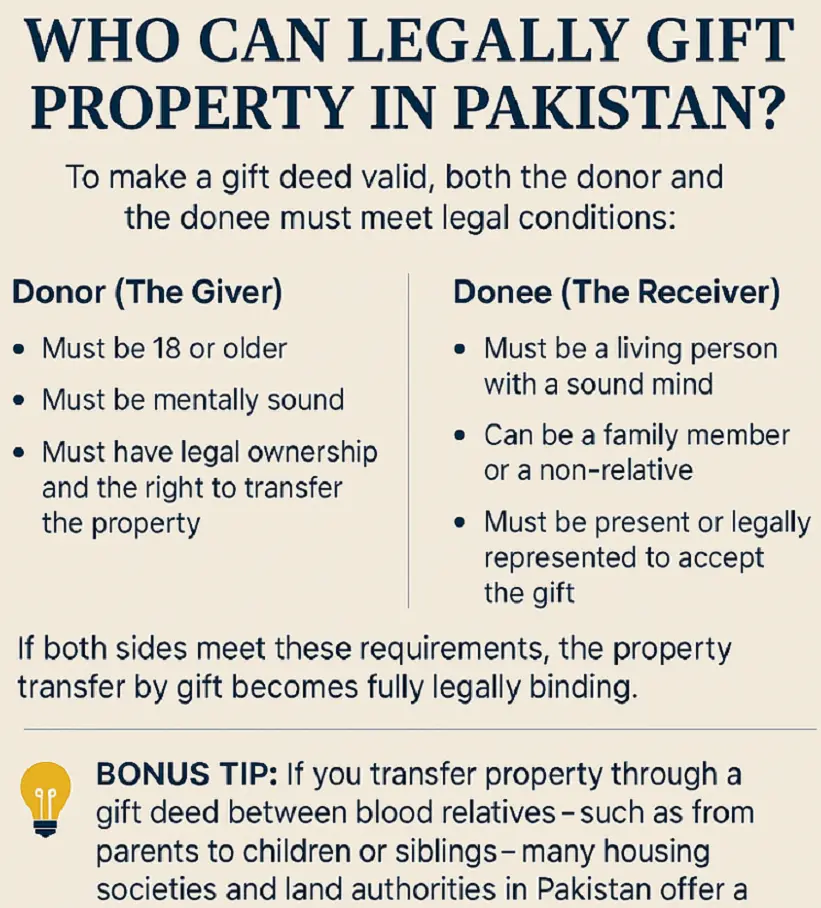
Who Can Gift Property in Pakistan?
A property owner can generally gift property during their lifetime if they own the property and are legally able to make the gift.
Donor: The Person Giving the Property
The donor (Wahib) should:
- Be 18 or older and hold a valid CNIC
- Be able to understand the gift and make the decision voluntarily
- Have legal ownership or the right to transfer the property
- Clearly intend to gift the property without consideration
Donee: The Person Receiving the Property
The donee (Mauhub Lahu):
- Can be a CNIC holder, family member, spouse, parent, child, sibling or non-relative, where applicable
- Must accept the gift
- Can accept personally or through a legally recognised representative, where applicable
Can I Gift Property to a Family Member?
Yes. You can generally gift property to a family member during your lifetime, subject to the applicable Hiba, registration and property-transfer requirements.
Common examples include:
- Father → Son or Daughter
- Mother → Son or Daughter
- Husband ↔ Wife
- Child → Parent
- Brother ↔ Sister
Buy or Sell in Airport Green Garden
Secure your next deal in Islamabad’s rising hotspot with verified listings and expert help. Whether you’re selling a 5 marla plot or buying a 1 kanal investment, we make it fast, transparent, and profitable.
What Makes a Hiba Valid?
For a Hiba to be valid, three key elements must be present:
- Declaration: the donor clearly declares the gift.
- Acceptance: the donee accepts the gift.
- Delivery of possession: possession is delivered to the donee.
In simple terms: Declaration → Acceptance → Possession
Documents Required for Gift Transfer
The documents you need depend on whether you transfer the property through a Revenue/Registrar Office, a land-record authority, a private developer or a housing society. Prepare the core documents first, then check the specific requirements of the authority handling your transfer.
From the Donor
The donor (Wahib) commonly provides:
- Affidavit by the Donor: confirms that the donor is making the gift voluntarily.
- Gift Declaration: states the donor’s intention to gift the property.
- Original CNIC and copy: used to verify the donor’s identity.
From the Donee
The donee (Mauhub Lahu) commonly provides:
- Gift Acceptance: confirms the donee’s acceptance of the gift.
- Undertaking by the Donee: confirms acceptance and any responsibilities required by the authority.
- Original CNIC and copy: used for identity and biometric verification, where required.
Property Documents
You may also need:
- Original ownership document: such as a sale deed, allotment letter or transfer letter.
- Proof of possession: where required to establish delivery or transfer of possession.
- Gift deed / Hiba document: where the authority requires a written instrument.
- Property-related clearances or NOCs: where required by the relevant authority or society.
Relationship & Supporting Documents
If the transfer involves a family relationship, you may need:
- Family Registration Certificate (FRC): can help establish the relationship between donor and donee.
- CNICs of witnesses: where the applicable procedure requires witnesses.
- Photographs or other supporting documents: if required by the authority or housing society.
Fees & Transfer Documents
You may also need:
- Stamp paper for the gift deed, where applicable.
- Stamp duty and registration fee receipt
- Transfer application or authority forms
- Mutation / inteqal documents, where applicable.
Tip: Keep the original documents and photocopies ready. Requirements vary, so confirm the current checklist with the Revenue/Registrar Office, land authority, developer or housing society before you visit.
Explore Airport Green Garden, Islamabad
Discover everything you need to know about Airport Green Garden, from plot sizes and prices to NOC status and development updates. Whether you’re buying, selling, or just researching, this area guide helps you make smarter property decisions.
How to Transfer Property Through Hiba
The process depends on which office or authority handles the property. First, find out where you need to complete the gift transfer.
Step 1: Identify the Office and Prepare Your Documents
First, confirm where you will process the Hiba or gift transfer.
- Revenue / Registrar Office: Prepare the gift deed, required documents and two witnesses. The donor and donee should visit the concerned Registrar Office.
- Private developer/housing society: Visit the society’s transfer office with the required documents and witnesses. The society may have its own forms and requirements.
Step 2: Submit the Documents and Complete the Process
Next, submit the gift deed and supporting documents to the relevant office or authority.
Complete the required document checks, signatures, biometric verification and fee payments, where applicable. The concerned authority or society will then process the property transfer.
Step 3: Collect Your Documents
Finally, collect your documents when the transfer is ready.
Depending on the authority, you may receive the registered gift deed, transfer letter, updated ownership document or other transfer records.
Tip: Check every name, CNIC number and property detail before leaving the office.
TopCity-1 Islamabad: Invest Smart in the Future
Looking for high ROI and modern amenities near the airport? Explore TopCity-1 Islamabad, a fast-growing, RDA-approved housing society offering residential and commercial plots from 5 marla to 2 kanal. Get location insights, price trends, NOC status, and development updates
Gift Hiba Fees in Pakistan 2026
How much does a Hiba property transfer cost?
There is no single fee for every gift transfer. Your total cost may include stamp duty, registration charges, mutation/inteqal fees and authority transfer charges.
The amount depends on the property, location, donor-donee relationship and authority handling the transfer.
Check the Closing Cost Before You Start
Here’s the key point: do not assume that a family Hiba is free or that all authorities charge the same fee.
Some private housing projects and societies charge 50% of their normal transfer fee for a gift transfer, while others have their own rates. Government authorities, such as the CDA, as well as land authorities in Punjab, Sindh, and Khyber Pakhtunkhwa, may also have different fees and procedures.
Before starting the transfer, ask the relevant authority for the complete closing cost. This can help you estimate the stamp duty, registration fee, mutation/inteqal fee and transfer charges before you proceed.
Hiba Fees in Punjab
In Punjab, stamp duty and other property-transfer charges depend on the property and transaction details. The official PLRA e-Stamping system calculates the applicable stamp duty, CVT, and other charges based on the property type, location, and transaction details.
For a gift instrument, Punjab’s current Stamp Act provides specific stamp-duty rates, including different treatment for certain close family relationships. Check the current e-Stamp calculation before paying.
Hiba Transfer Fee in Islamabad
For CDA properties, the transfer fee depends on the type of transfer and the current CDA schedule.
CDA has separate treatment for family transfers, legal-heir transfers, inclusion of name and oral gift transfers. A later 2026 CDA Board decision reduced the general property transfer fee from 3% to 1% of FBR value.
Do not apply the general 1% rate to a family Hiba without checking the specific CDA category.
Stamp Duty on Gift Deed
Stamp duty is separate from the transfer fee. The applicable amount depends on the province, property value and relationship between the donor and donee.
In Punjab, the Stamp Act provides different treatment for gifts between certain close family members.
Gift Deed Registration Charges
If you register a gift deed, registration charges may apply in addition to stamp duty and other transfer costs.
The exact amount depends on the applicable provincial rules, the property, and the transfer authority.
Hiba Mutation / Inteqal Fee
After a gift transfer, you may need to update the official land record through mutation (inteqal).
In Punjab, PLRA treats mutation as the official recording of a change in land ownership after a gift or other transfer. The applicable fee is generated through the relevant land-record process.
Hiba Fees for Blood Relatives
A gift between close family members may receive different fee or stamp-duty treatment from a gift to a non-relative.
However, blood relation does not automatically make all fees or taxes zero.
Always check the current rate for your province, property authority and relationship before completing the Hiba transfer.
These rates may vary by city, property type, and the relationship between the donor and donee.
Tax on Hiba Property in Pakistan
Is Hiba property taxable in Pakistan?
Here’s where it gets important: income tax and property-transfer charges are not the same thing.
A property gift does not automatically create an income-tax liability simply because the ownership changes. However, the transfer may still involve stamp duty, registration fees, mutation/inteqal fees or authority transfer charges, depending on the property and applicable rules.
Under Section 79 of the Income Tax Ordinance, 2001, gifting an asset to a relative as defined in Section 85 does not result in a gain or loss being recognised for tax purposes.
The law also provides specific treatment for property or other assets received as gifts. Gifts from relatives covered by the law are excluded from income under the relevant provisions.
Is Hiba to a Family Member Tax-Free?
A gift to a qualifying relative may receive favourable income-tax treatment. However, this does not make the entire Hiba transfer free from taxes, fees or other charges.
You may still have to pay:
- Stamp duty
- Registration charges
- Mutation / inteqal fee
- Authority or housing-society transfer charges
- Other applicable property-transfer charges
The exact cost depends on the province, property authority, relationship and type of transfer.
Who Is a Relative for Tax Purposes?
For tax purposes, Section 85 defines “relative” to include certain family relationships, such as an ancestor, a descendant of a grandparent, an adopted child and a spouse.
So, do not assume that every family or blood relationship receives the same tax treatment. Check whether the specific relationship falls within the legal definition.
Hiba vs Property Transfer Charges
This distinction is important:
Income-tax treatment determines whether the gift creates taxable income or a gain for the parties.
Property-transfer charges are separate costs imposed under the applicable provincial, land-record, registration or authority rules.
So, even when a Hiba qualifies for favourable income-tax treatment, you should still check the stamp duty, registration fee, mutation fee and transfer charges before completing the transfer.
Important: Tax rules can change. Before transferring valuable property, check the current FBR rules and the applicable provincial or authority charges for your specific property and relationship.
Hiba Law and Rules in Pakistan
Hiba in Pakistan is governed mainly by Muslim personal law, along with applicable property, registration and land-record laws.
For a valid Hiba, Pakistani courts generally recognise three essential requirements:
- Declaration: the donor clearly declares the gift.
- Acceptance: the donee accepts the gift.
- Delivery of possession: possession or control of the property is delivered to the donee.
The Supreme Court of Pakistan has repeatedly recognised these three requirements for a valid Hiba.
A Hiba may be oral under Muslim law, but it must still satisfy these essential requirements. Written documents, registration and mutation may also be important for proving and recording the transfer, depending on the property and applicable procedure.
In simple terms: A gift deed or written declaration alone does not automatically prove a valid Hiba. The declaration, acceptance and delivery of possession must also be established.
Can a Hiba Be Challenged?
Yes. A Hiba can be challenged in court if there is a valid legal ground to dispute the gift.
A challenge may arise where the required elements of Hiba are not proved, such as declaration, acceptance or delivery of possession. A gift may also be disputed on grounds such as fraud, undue influence, lack of free consent or other defects in the transaction.
The person challenging the Hiba generally needs to support the allegations with reliable evidence. In one Supreme Court case, a donor’s earlier statements and the mutation record supported the validity of the gift, while the allegation of fraud was not proved.
When Can a Hiba Be Challenged?
Common grounds may include:
- No clear declaration of the gift
- No acceptance by the donee
- No delivery of possession
- Fraud or forgery
- Undue influence or lack of free consent
- Questions about the donor’s ability to make the gift
- Insufficient evidence proving the original Hiba
Important: A gift deed or mutation entry alone does not always settle the matter. The court may examine whether the essential requirements of the Hiba were actually fulfilled.
Common Mistakes When Transferring Property Through Hiba
A Hiba can create problems later if the transfer is not properly completed or documented. Courts have repeatedly focused on declaration, acceptance and delivery of possession when deciding whether a Hiba was valid.
Avoid these common mistakes:
- Relying only on a verbal promise without properly proving the declaration, acceptance and delivery of possession.
- Not delivering possession or failing to take steps demonstrating that the donee has control of the property.
- Assuming a gift deed alone completes the Hiba.
- Using the wrong documents for the relevant Revenue Office, land authority or housing society.
- Not updating the mutation/inteqal when the applicable process requires it.
- Assuming blood relatives pay no fees or taxes.
- Starting the transfer without checking the complete closing cost.
- Keeping incorrect names, CNIC numbers or property details in the transfer documents.
- Ignoring the authority’s current requirements, which can differ between provinces, CDA and private housing societies.
The smart move: confirm the Hiba requirements, documents, fees and possession arrangements before starting the transfer. This can reduce delays and help prevent disputes later.
Common Gift Scenarios in Pakistan
| Recognised under Islamic gift transfer law | Tax & Registration Benefit |
| Father to Son/Daughter | Often 50% off stamp duty, no CGT |
| Husband ⇄ Wife | Recognised under Islamic gift transfer law |
| Brother ⇄ Sister | Recognized under Islamic gift transfer law |
Key Takeaway
Hiba is a common way to transfer property during the owner’s lifetime, especially to family members.
A Hiba can have different tax and fee treatment than a sale or inheritance, but that does not automatically mean all taxes and transfer charges are zero. You may still need to pay stamp duty, registration, mutation/inteqal or authority transfer charges, depending on the property and location.
To complete the transfer properly, make sure the Hiba requirements, documents, possession and property-record formalities are handled correctly.
Check the applicable fees and requirements before starting the transfer to avoid delays, unexpected costs and future disputes.
FAQs About Hiba in Pakistan
Hiba is a voluntary gift of property under Muslim law, made without consideration. A valid Hiba generally requires declaration by the donor, acceptance by the donee and delivery of possession.
Yes. A person can generally make a Hiba to a child during their lifetime, subject to the applicable Hiba, property-transfer and land-record requirements.
Under Muslim law, a Hiba may be made orally if its essential requirements are fulfilled. However, proper documentation and updating the relevant property records can provide important evidence of the transfer.
A qualifying gift to a relative can receive specific income-tax treatment under Pakistan’s tax law. However, this does not automatically remove stamp duty, registration fees, mutation fees or authority transfer charges.
There is no single Hiba fee for all properties. The total cost depends on the province, property, relationship and authority. It may include stamp duty, registration, mutation/inteqal and transfer charges.
Yes. Property can generally be gifted to a spouse, child, parent, sibling or other eligible person, subject to the applicable rules and authority requirements.
No. Hiba refers to the gift transaction under Muslim law, while a gift deed is a written document used to record the gift and complete applicable formalities.
Stamp duty may apply depending on the province, the property, and the relationship between the donor and the donee. Check the current rate before completing the transfer.
There is no fixed time for every Hiba transfer. Processing time depends on the relevant Revenue Office, land authority, CDA, developer or housing society and whether all required documents are complete.