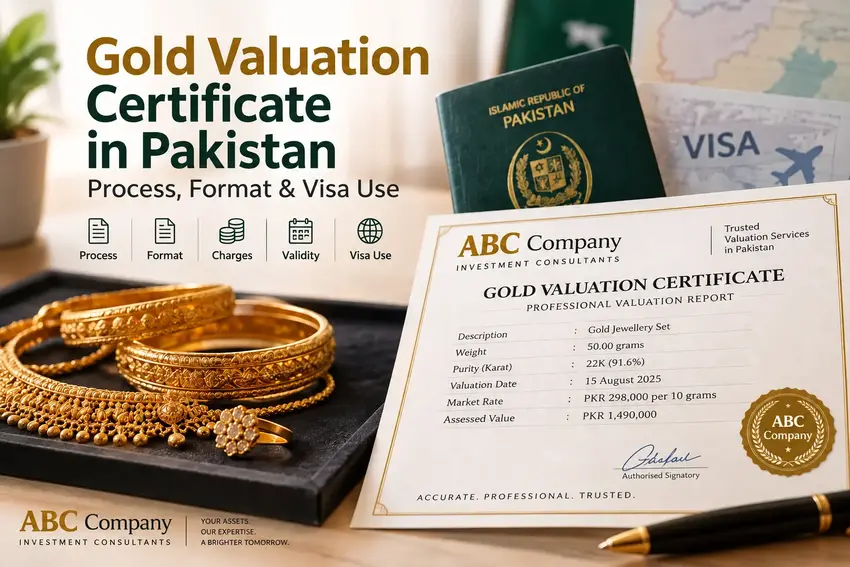
Gold Valuation Certificate in Pakistan: Complete Guide
-
Written by:
 Shamsheer Ali Turk
 - Last updated: September 13, 2026
- Valuation
A gold valuation certificate in Pakistan is a formal document that records the assessed market value of gold or jewellery on a specific valuation date. It can include the jewellery description, gold weight, purity, karat, applicable gold rate, and assessed value.
The exact requirements depend on the purpose. A professional gold valuation report may support visa, immigration, tax, inheritance, insurance, or legal matters. The receiving authority may also require specific details, signatures, stamps, or other supporting documents.
What You’ll Learn
- What is a Gold Valuation Certificate?
- How is Gold Jewellery Valued?
- What Does a Gold Valuation Certificate Contain?
- What Is a Gold Valuation Certificate Used For?
- How to Get a Gold Valuation Certificate in Pakistan
- Documents Required
- Format
- How much does it cost?
- FAQs
What Is a Gold Valuation Certificate?
A gold valuation certificate is a formal document that records the assessed market value of gold or jewellery on a specific valuation date. It can include details such as the jewellery description, weight, purity, karat, applicable gold rate, and assessed value.
The exact contents may vary depending on the purpose of the assessment and the requirements of the organisation receiving the document. For example, a valuation prepared for visa, immigration, tax, inheritance, insurance, or legal matters may require different supporting information.
Gold Valuation Certificate vs Gold Valuation Report
The terms valuation certificate and valuation report are often used interchangeably, but their formats and levels of detail can vary.
A certificate may provide a concise record of the assessed value, while a detailed report can explain the jewellery items, gold weight, purity, valuation method, market rate, valuation date, and final assessed amount.
Why Gold Valuation Certificates Matter
Gold and jewellery can form an important part of a person’s assets. A gold valuation certificate provides a documented assessment of their value on a specific date.
Depending on the purpose, a professional gold valuation report may support visa and immigration applications, tax and wealth statements, inheritance, insurance, or legal matters. It can record key details such as weight, purity, karat, jewellery description, gold rate, valuation date, and assessed value.
However, document requirements vary by the receiving authority. A report prepared for a specific purpose should therefore include the information and supporting details that the authority requires.
If you need a gold valuation for visa, visit the jewellery valuation certificate for visa
Can You Get a Gold Valuation Certificate Online in Pakistan?
Yes, you can start a gold valuation certificate online in Pakistan. The process can begin by sharing your purpose, CNIC or passport details, jewellery information, photographs, and any available supporting documents. The valuer then determines whether the valuation can be completed remotely or requires physical inspection.
For a professional valuation, see our gold valuation services in Pakistan.
How Is Gold Jewellery Valued?
Gold jewellery is valued based on several factors rather than weight alone. The assessment considers the gold content, purity, applicable market rate, gemstones, and other relevant characteristics. These details are then used to determine the assessed value on the valuation date.
Gold Weight
The valuer records the weight of the jewellery and, where relevant, distinguishes between gross weight and net gold weight. Stones and other non-gold components may affect the final weight used in the assessment.
Purity & Karat
The purity of gold affects its value. Jewellery may be identified by its karat, such as 24K, 22K, 21K, or 18K. The purity or fineness helps determine the amount of gold contained in the item.
Gemstones & Diamonds
If jewellery contains diamonds, gemstones, or other precious stones, these components may be considered separately from the gold content. Their characteristics and value can affect the overall assessment.
Applicable Gold Rate
The valuation uses an appropriate gold market rate for the valuation date. Since gold prices change over time, the applicable rate and date should be clearly recorded in the valuation report.
Final Assessed Value
After considering the relevant weight, purity, gold rate, gemstones, and other valuation factors, the valuer determines the assessed value. The final report records this amount along with the valuation date and relevant item details.
What Does a Gold Valuation Certificate Contain?
A well-prepared valuation certificate identifies the applicant, the jewellery assessed, and the value determined on the valuation date. The exact format can vary by purpose, but a professional report should clearly present the key information that supports the stated value.
Applicant Details
The report may include the applicant’s full name, CNIC or passport number, and other identification details required for the stated purpose. For visa or immigration cases, these details should match the applicant’s supporting documents.
Jewellery Details
Each item can be described by its type, quantity, design or identifying features, with photographs where applicable. Common items include rings, bangles, necklaces, bracelets, earrings, chains, coins, and gold bars.
Weight & Purity
The report records relevant weight and purity details, including gross weight, net gold weight, karat, or fineness where available. If an item contains stones or other materials, these may be considered separately when determining the gold content.
Current Market Gold Rate
The valuation report can state the gold market rate used as of the valuation date. This may include the applicable rate per gram, 10 grams, or tola, depending on the valuation method and reporting format.
Because gold prices change, recording both the rate and valuation date helps show which market reference was used to determine the assessed value.
Currency
The report should clearly state the currency in which the valuation is presented. For a valuation prepared in Pakistan, the amount may be shown in Pakistani Rupees (PKR). Where the report is prepared for overseas purposes, the destination-country currency may also be shown alongside PKR, where required.
For example:
Assessed Value: PKR 5,000,000
Equivalent Value: CAD 24,000
The applicable conversion rate and valuation date should be clear when a foreign-currency equivalent is included.
Valuation Details
This section records the valuation date, assessed value, applicable currency, and relevant valuation basis. It may also identify the market rate or other factors used to arrive at the stated amount.
Valuer Details
The document should identify the valuer or valuation firm responsible for the assessment. It may include the valuer’s name, professional details, report reference, signature, stamp, and, where applicable, the date of issue.
What Is a Gold Valuation Certificate Used For?
A professional gold or jewellery valuation can support different financial, legal, and administrative needs. The information included in the report should align with the purpose of the assessment and, where applicable, with the requirements of the organisation receiving it.
Visa Applications
Applicants may include a jewellery valuation among their supporting documents when an immigration authority requests evidence of assets or financial circumstances. The report can document the assessed value of gold jewellery and provide details such as weight, purity, valuation date, and currency.
For visa-specific requirements, see our jewellery valuation certificate for visa guide.
A valuation report is supporting evidence. It does not guarantee visa approval or replace financial documents specifically required by the immigration authority.
Visa and immigration authorities may have different requirements for financial evidence and supporting documents. Always check the requirements for your destination country before ordering a valuation.
Immigration
For immigration or permanent-residence applications, applicants may need to document their assets, net worth, or financial position. A jewellery valuation can provide a documented assessment of gold holdings when such evidence is relevant to the application.
The receiving authority determines whether the valuation is suitable and what other financial documents must be submitted.
Tax & Wealth Statements
Gold and jewellery can form part of a person’s assets or wealth. A valuation may help document the value of these holdings when preparing financial records or responding to a specific documentation requirement.
However, the treatment of jewellery for tax purposes can vary. Gold and jewellery can also appear in wealth documentation. FBR’s wealth statement includes jewellery, ornaments, metals, and stones under the heading of precious possessions.
A valuation report should therefore be used in accordance with the requirements of the relevant tax filing or authority.
Inheritance
A jewellery valuation can help establish the assessed value of gold and other precious items when dealing with an inheritance or estate.
It may be useful when:
- documenting inherited jewellery
- preparing an estate inventory
- determining values for family settlement
- recording individual jewellery items
- supporting succession-related documentation
The valuation provides a documented value as of the stated valuation date; it does not, by itself, determine legal ownership or inheritance shares.
Insurance
A valuation report can help document the value and characteristics of jewellery for insurance purposes.
Depending on the insurer’s requirements, the report may record:
- jewellery description
- weight
- purity
- gemstones or diamonds
- photographs
- assessed value
- valuation date
Always check whether your insurer requires a particular valuation format or a recent assessment.
Personal Asset Records
You can also obtain a professional valuation for your own asset records and financial planning.
It can provide a dated record of your jewellery holdings, including:
- item description
- weight and purity
- assessed value
- valuation date
- currency
This can be useful when reviewing your overall assets, updating records, or keeping documentation for future reference.
Important: A gold valuation certificate does not replace customs declarations, import/export requirements or applicable duties. If you are travelling with gold jewellery, check the latest Pakistan Customs passenger declaration requirements.
How to Get a Gold Valuation Certificate in Pakistan
Getting a professional gold valuation certificate in Pakistan starts with explaining to the valuer why you need it. You can begin the process online by sharing your jewellery details and supporting documents. The process then moves through assessment, report preparation, and final review.
Step 1: Tell the Valuer Your Purpose
Start by explaining why you need the valuation. Tell the valuer whether it is for a visa, immigration, tax, inheritance, insurance, travel, or personal records.
If an embassy, immigration consultant, insurer, bank, or other organisation has given you specific document requirements, share them before the assessment.
Step 2: Share Jewellery Details
Provide the available details about your gold or jewellery, such as:
- Type of jewellery
- Number of items
- Approximate weight
- Purity or karat, if known
- Photographs, where applicable
- Purchase receipts or invoices, if available
- Previous valuation reports, if available
This information helps the valuer understand the items and determine what further assessment may be needed.
Step 3: Inspection & Assessment
The valuer assesses the jewellery using the information and inspection method appropriate to the stated purpose.
The assessment may consider weight, purity, karat, gold content, gemstones, diamonds, condition, and other relevant characteristics.
Examine the jewellery directly to verify the relevant details whenever physical inspection is required.
Step 4: Report Preparation
After the assessment, the valuer prepares the gold valuation report or certificate with the relevant findings.
Depending on the purpose, it may include the jewellery description, weight, purity, applicable market gold rate, valuation date, assessed value, currency, and valuer details.
The report format can vary according to the purpose and requirements of the receiving organisation.
Step 5: Review & Issue
Review the key details, including your name, jewellery description, weight, purity, valuation date, currency, and assessed value, before issuing the final document.
Once you confirm the required information, issue the completed gold valuation certificate or report in the agreed format.
Gold Valuation Certificate Format
Adjust the format to suit the purpose and type of the asset being valued. A gold valuation certificate may provide a concise summary of the asset and its assessed value, while a detailed jewellery valuation report can provide an item-by-item breakdown.
What a Gold Valuation Certificate Can Show
A certificate may record the main details of the asset, such as:
- Type of asset: jewellery, gold bar, coin, or other gold item
- Total weight
- Purity or karat
- Current market gold rate as of the valuation date
- Total assessed value
- Valuation date
- Currency: PKR and, where required, the relevant foreign currency
- Applicant and valuer details
For a collection of jewellery, the certificate can therefore present the total weight, purity, and overall assessed value rather than providing a separate valuation for every individual piece.
What a Detailed Jewellery Valuation Report Can Show
A detailed report can provide a separate entry for each jewellery item, making it easier to identify and assess individual pieces.
For example:
| Item | Description | Weight | Purity/Karat | Assessed Value |
|---|---|---|---|---|
| 1 | Gold necklace | — | — | — |
| 2 | Gold bangles | — | — | — |
| 3 | Gold ring | — | — | — |
Depending on the assignment, a detailed report may also include gemstones, diamonds, photographs, item-specific observations, gold content, valuation method, and other supporting details.
Certificate vs Detailed Valuation Report
The simplest distinction is:
Gold valuation certificate: concise summary of the assessed asset and its value.
Detailed jewellery valuation report: itemised assessment with greater detail about individual jewellery pieces.
The appropriate format depends on what is being valued, why the valuation is required, and what the receiving organisation asks for.
This is much better than the previous version because it doesn’t incorrectly imply that every certificate contains an item-by-item jewellery schedule.
Who Can Issue a Gold Valuation Certificate in Pakistan?
The person or firm preparing a gold valuation report should have the appropriate professional expertise and be able to provide a clear, documented assessment of the jewellery or gold being valued.
The right choice also depends on why you need the valuation. A visa application, tax matter, inheritance case, insurance claim, or other official purpose may have different requirements for the type of valuer or report.
Before ordering, check whether the receiving organisation specifies:
- A particular type of valuer or valuation firm
- Professional credentials or registration
- Physical inspection or another assessment method
- Specific report contents
- Signature, stamp, or verification details
- A recent valuation date
What Should You Check Before Choosing a Valuer?
Look for a professional who can clearly explain the valuation method, the gold rate used, the weight and purity assessment, the report format, and the supporting documentation.
A good valuation report should make it clear what was assessed, when it was assessed, how the value was determined, and who prepared the report.
If you need a valuation for a specific purpose, tell the valuer that purpose before the assessment. This helps ensure the report contains the relevant information for your intended use.
ICONS also provides property valuation services for visa, tax and other purposes.
What Documents Are Required?
The documents needed for a gold or jewellery valuation depend on the purpose of the assessment and the requirements of the organisation receiving the report. You may not need every document listed below.
Commonly requested information includes:
- CNIC or Passport: to identify the person requesting the valuation.
- Jewellery details: information about the type, number, and approximate weight of the items.
- Photographs: clear images can help with an initial review or remote pre-assessment, where applicable.
- Purchase receipt or invoice: useful if available, especially when it provides details about the jewellery.
- Previous valuation report: if the jewellery has been valued before.
- Purpose of valuation: such as visa, immigration, tax, inheritance, insurance, travel, or personal records.
- Receiving authority’s requirements: any specific format, information, currency, or document requirements provided by an embassy, consultant, insurer, court, or other organisation.
Do You Need the Original Jewellery?
Whether the jewellery must be physically presented depends on the valuation method and purpose. If physical inspection is required, the valuer will need access to the items being assessed.
For an online enquiry, you can usually start by sharing your jewellery details, photographs, any available documents, and the purpose so the valuer can explain the next steps.
Tip: If your valuation is for a visa, immigration, tax, inheritance, or insurance matter, share the receiving organisation’s requirements before the assessment. This helps the valuer prepare the report with the relevant information.
Gold Jewellery Valuation Experience
This year alone, ICONS has issued more than 145 gold jewellery valuation certificates for clients with different documentation needs.
Our experience also includes valuations prepared for visa and immigration applications. Clients have shared feedback with us after using their valuation documents in their applications, including cases in which they subsequently obtained their visas.
However, every visa application is assessed by the relevant immigration authority on its own merits. A gold jewellery valuation certificate is supporting documentation and does not guarantee visa approval.
Gold Valuation vs Jeweller’s Estimate
A jeweller’s estimate and a professional gold valuation can serve different purposes. A jeweller may provide a price estimate for buying, selling, or exchanging an item, while a valuation report documents an assessed value based on the details and purpose of the assignment.
What Is the Difference?
| Gold Valuation | Jeweller’s Estimate |
|---|---|
| Prepared for a stated valuation purpose | Often prepared for a commercial transaction |
| Documents the assessed value | Usually provides an estimated buying or selling price |
| Can record weight and purity | Details provided can vary |
| Identifies the valuation date | Date or valuation basis may vary |
| Can include valuer and report details | Format varies by jeweller |
How Online Gold Valuation Works
- Tell us your purpose: visa, immigration, tax, inheritance, insurance, travel, or personal records.
- Share jewellery details: item type, approximate weight, known purity, and clear photographs where applicable.
- Provide available documents: CNIC/passport, receipts, previous reports, or specific requirements from the receiving organisation.
- Confirm the assessment process: we’ll explain whether physical inspection or additional information is required.
- Receive the valuation report: once the required assessment is completed, the report is prepared with the relevant valuation details.
Can a Valuer Complete the Final Valuation Without Seeing the Jewellery?
That depends on the purpose, valuation method, and report requirements. Do not assume that an online estimate is suitable for an official application.
At ICONS, you can begin the valuation process online. First, we review your information and requirements. Then, our valuer selects the appropriate assessment method for your case.
Need to start online? Tell us what you need the valuation for and we’ll guide you through the next step.
How Recent Should a Gold Valuation Certificate Be?
A gold valuation certificate does not have one fixed validity period. Its required age depends on the purpose of the valuation and the organisation receiving the report.
Because gold prices change, authorities and institutions may prefer a recent valuation with a clearly stated valuation date.
If your visa, immigration, insurance, tax, or other application specifies a time limit, follow that requirement. Otherwise, ask the receiving organisation or your valuer whether you need a fresh valuation.
Gold Valuation Charges in Pakistan
Gold valuation charges vary based on the number of items, report type, assessment requirements, and the purpose of the valuation. A simple certificate generally costs less than a detailed jewellery valuation report that requires item-by-item assessment, photographs, gemstone details, or additional verification.
At ICONS, current packages range from PKR 5,000 to PKR 25,000, depending on the scope of the valuation.
The final fee can depend on:
- Number of jewellery items
- Type of asset: jewellery, gold bars, coins, or mixed items
- Level of detail required in the report
- Gemstones or diamonds that require additional assessment
- Purpose of the valuation
- Inspection or verification requirements
- Urgency, where applicable
For example, a detailed jewellery report with item-by-item information may require more assessment than a concise certificate that shows the total weight, purity, market rate, currency, and assessed value.
Need to know the exact fee? Share your jewellery details and purpose with us, and we’ll confirm the appropriate valuation option and charges.
Do You Need a Purchase Receipt?
Not always. A purchase receipt or invoice can provide useful information about jewellery, but whether you need one depends on the purpose of the valuation and the requirements of the organisation receiving the report.
If you have a receipt, it may help confirm details such as:
- Date of purchase
- Jewellery description
- Weight
- Gold purity or karat
- Purchase price
- Seller details
If you do not have the original receipt, tell the valuer before the assessment. Inherited, gifted, older, or family jewellery may not have an invoice available, and the valuation can be based on information and assessment appropriate to the stated purpose.
What If You Don’t Have a Receipt?
You can still start by providing the available information about the jewellery, such as photographs, approximate weight, known purity, previous valuation documents, and your purpose for the assessment.
The valuer can then tell you whether you need additional documents or a physical inspection.
Tip: If your valuation is for a visa, immigration, tax, inheritance, insurance, or other official purpose, check the receiving organisation’s document requirements before ordering. A purchase receipt may support your file, but it cannot replace the valuation report when authorities specifically request one.
Final Thoughts
A gold valuation certificate provides a dated record of the assessed value of your gold or jewellery. A professional valuation can support visa, immigration, tax, inheritance, insurance, travel, or personal documentation, depending on the requirements of the organisation receiving it.
The right report should clearly identify the asset, weight, purity, valuation date, applicable market rate, assessed value, currency, and valuer details. Before ordering, confirm the requirements for your specific purpose so the report contains the information you need.
If you need professional help, explore our gold valuation services.
FAQs – Gold & Jewellery Valuation Certificates
A gold valuation certificate is a formal document that records the assessed value of gold or jewellery on a specific valuation date.
The assessment can consider weight, purity, karat, gold content, gemstones, diamonds, applicable market rate, and other relevant factors.
Not always. Requirements depend on the purpose of the assessment. A receipt or invoice can provide useful supporting information when available.
A gold valuation does not have one fixed validity period. The required age depends on the purpose and the organisation receiving the report.
Yes, if issued by a certified valuer in an accepted format.
Yes. You can have inherited and gifted jewellery assessed. The valuer may require available details or supporting documents depending on the purpose.
Yes. You can start the process online by sharing your purpose, jewellery details, photographs, and available documents. The required assessment method depends on the purpose and report requirements.
A gold valuation does not have one fixed validity period. The required age depends on the purpose and receiving organisation.
No. A valuation is supporting documentation. It does not guarantee visa approval or replace financial and other documents required by the immigration authority.