

Petrol Price in Pakistan Today (Live – Rs. 316.15/Ltr) 15-10-2026 | Latest OGRA Update
-
Written by:
 Icons Team
 - Last updated: July 20, 2026
- Market Updates

Petrol Price in Pakistan Today (Live)
Last updated: 15 October 2026 – 6:00 AM (PKT)
Petrol (Super): Rs. 316.15 per litre
Diesel (HSD): Rs.354.35 per litre
Disclaimer: Prices are exclusive of applicable freight charges from the respective shipping point to the retail outlet. Final selling prices at retail outlets include applicable freight charges.
Source: Oil and Gas Regulatory Authority (OGRA)
According to OGRA, fuel prices are revised every 15 days.
Whether you’re filling your car, planning business transport costs, or tracking fuel price trends, these rates give you the most accurate and official prices nationwide.
Petroleum Prices in Pakistan Today
| Petroleum Type | Price (PKR/Litre) |
|---|---|
| Petrol (Super) | 316.15 |
| High Speed Diesel (HSD) | 354.35 |
| Light Diesel Oil (LDO) | 199.98 |
| Superior Kerosene Oil (SKO) | 272.00 |
Tip: Prices are revised roughly twice a month by OGRA and PSO. Always check daily updates before refuelling.
Diesel Price in Pakistan Today
| Petroleum Type | Price (PKR/Litre) |
|---|---|
| High-Speed Diesel (HSD) | 354.35 |
Note: Diesel prices are uniform nationwide as per OGRA. HOBC (High Octane) pricing may vary slightly across fuel stations.
PSO Petrol Price in Pakistan Today – Latest Fuel Rates Update
Looking for the latest PSO petrol price in Pakistan today? Here are the updated Pakistan State Oil (PSO) fuel rates effective from 18 June 2026 for petrol, diesel, LPG, kerosene oil, and Euro 5 fuels.
PSO is Pakistan’s largest fuel supplier. Therefore, most people search daily for PSO petrol prices in cities like Islamabad, Rawalpindi, Lahore, Karachi, and Peshawar to track fuel costs and manage their budgets.
| Product | Price (PKR/unit) |
|---|---|
| Petrol (Premier Euro 5) | 316.15/litre |
| High-Speed Diesel (Euro 5) | 354.35/litre |
| Light Diesel Oil (LDO) | 275.54/litre |
| Superior Kerosene Oil (SKO) | 313.44/litre |
| JP-1 Fuel | 332.32/litre |
| LPG (Liquefied Petroleum Gas) | 308.76/kg |
Fuel prices are revised based on government notifications, international oil prices, freight charges, and dealer margins. As a result, final retail prices may vary slightly by city and petrol pump location.
New Petrol Price in Pakistan (Latest Update)
Track today’s petrol price and changes from previous rates:
| Petroleum Type | Old Price (PKR) | New Price (PKR) | Difference |
|---|---|---|---|
| Petrol | 310.71 | 316.15 | +06.68 |
| High-Speed Diesel (HSD) | 323.30 | 354.35 | +11.83 |
| Light Diesel Oil (LDO) | 244.93 | 275.54 | +30.61 |
| Kerosene Oil (SKO) | 467.48 | 272.00 | -195.48 |
Fuel Price Change Summary (Updated – Pakistan)
- Petrol: Increased by PKR 11.21 /litre
- High-Speed Diesel (HSD): Increased by PKR 11.83/litre
- Light Diesel Oil (LDO): Increased by PKR 30.61/litre
- Superior Kerosene Oil (SKO): Decreased by PKR 195.48/litre
Tip: Prices are revised roughly twice a month by OGRA and PSO. Always check daily updates before refueling.
Pakistan imports most of its fuel, so petrol prices are also influenced by international crude oil markets and currency exchange rates.
Still waiting for relief at the pump? Stay informed with our latest petrol price news and updates, including official figures.
You may also like:
- LPG rate today
- Gas Price in Pakistan Today
- Explore Osaka Battery Prices in Pakistan Today
- Discover Marble Prices in Pakistan Today
- Current Steel Price in Pakistan
- Battery Rates in Pakistan (today)
Petrol Price in Major Cities of Pakistan
| City | Petrol (PKR/Litre) | Diesel / HSD (PKR/Litre) | Kerosene / Other |
|---|---|---|---|
| Karachi | 316.15 | 354.35 | SKO: 272.00 / HOBC: varies |
| Lahore | 316.15 | 354.35 | SKO: 272.00 / HOBC: varies |
| Islamabad | 316.15 | 354.35 | SKO: 272.00 / HOBC: varies |
| Rawalpindi | 316.15 | 354.35 | SKO: 272.00 / HOBC: varies |
| Faisalabad | 310.71 | 354.35 | SKO: 272.00 / HOBC: varies |
Note: Petrol & diesel prices are uniform nationwide as per OGRA. HOBC (High Octane) prices vary by pump.
Note:
- Petrol & Diesel are the same nationwide.
- HOBC (High Octane) has no OGRA-controlled price, so each company sets its own.
- Freight differences are too small to publish at the city level.
Petrol & Diesel Price History in Pakistan (2023–2025)
Here is the verified OGRA and PSO fuel price revisions, historic highs, and official notes, giving a clear timeline of petrol and diesel rates, compliance updates, and market trends:
| Effective Date | Petrol (Rs/Litre) | Diesel / HSD (Rs/Litre) | Notes / Source |
| 16 Sep 2023 | 331.38 | 329.18 | Historic high. |
| 16 Dec 2023 | 267.34 | 276.21 | Post-revision drop. |
| 01 Jan 2024 | 260.65 | 264.21 | Early-2024 baseline. |
| 01 Dec 2024 | 252.10 | 258.43 | End-of-year rate. |
| 01 Mar 2025 | 255.63 | 263.95 | Official revision. |
| 01 Jul 2025 | 266.79 | 272.98 | Mid-year hike. |
| 16 Sep 2025 | 264.61 | data not confirmed | OGRA/PSO announced no petrol rise; diesel price adjusted. |
| 01 Oct 2025 | 268.68 | 276.81 | New fortnight revision. |
| 16 Oct 2025 | 263.02 | 275.42 | Mid-month adjustment. |
| 01 Nov 2025 | 265.45 | 278.44 | Official revision. |
| 16 Nov 2025 | 265.45 | 284.44 | Diesel jump; petrol steady. |
| 01 Dec 2025 | 263.45 | 279.65 | Latest published price. |
| 17 Dec 2025 | 263.45 | 265.65 | Latest prices. |
| 05-04-2026 | 321.17 | ≈378.41 | Peak historic high. |
Use this timeline to track trends and plan fuel purchases wisely.
Notes on Data & Use
- The highest recorded petrol price in this period, Rs 378.41/L on 03-04-2026, matches data from a widely cited archive.
- Every date with petrol price also typically included a diesel price revision, except where diesel data was missing; leave those blank until you confirm with OGRA/PSO notices.
- Petrol and diesel prices are revised roughly twice a month by the Oil & Gas Regulatory Authority (OGRA) / Pakistan State Oil (PSO).
- Use this table to show users how fuel prices moved over time. It builds trust and demonstrates transparency.
What Affects Petrol Prices in Pakistan?
Fuel prices fluctuate due to multiple factors:
- Global Oil Trends – International crude rates heavily influence local prices.
- Exchange Rate (USD/PKR) – A weaker rupee increases fuel costs.
- Taxes & Subsidies – Government levies and incentives directly affect pump prices.
- Refining & Freight Costs – Shipping and logistics add to final retail rates.
- Market Demand – Higher demand may trigger short-term adjustments.
Staying informed allows households and businesses to budget for transportation costs effectively.
Stay ahead of market trends, track today’s silver rate in Pakistan, and make smarter investment decisions with real-time updates.
Overview of Petroleum
Crude oil forms underground over millions of years as ancient organisms decay.
Refineries extract and process it into petroleum-based fuels, such as gasolene and diesel, which power vehicles, industries, and electricity generation. Petroleum is also the base for countless products, including plastics, lubricants, and synthetic fibres. Its role in transportation, manufacturing, and energy makes it one of the most valuable resources globally.
That’s why petroleum remains essential to modern life.
Types of Petroleum Products
Below are the common types of petroleum and their current prices:
- Petrol (Super)
- High-Speed Diesel (HSD)
- Light-Speed Diesel (LSD)
- Kerosene
- Liquefied Petroleum Gas (LPG)
- Compressed Natural Gas (CNG)
Petroleum Products Overview
| Product | Current Price | Use / Notes |
|---|---|---|
| Petrol (Super) | 316.15/Ltr | Cars & bikes fuel (daily transport) |
| High-Speed Diesel (HSD / Hi-Cetane Euro 5) | 354.35/Ltr | Commercial trucks, buses, heavy transport |
| Light Diesel Oil (LDO) | 275.54/Ltr | Medium machinery, small power equipment |
| Superior Kerosene Oil (SKO) | 272.00/Ltr | Heating, industrial use, rural cooking |
| JP-1 Fuel | 283.52/Ltr | Aviation / industrial fuel |
| LPG (Liquid Petroleum Gas) | 303.81/kg | Household cooking, commercial fuel, vehicles |
| CNG | Varies | Alternative fuel for vehicles |
Discover the 5 Hidden Forces That Shape Property Prices in Pakistan!
From zoning laws to market demand, learn how location, supply, economy, and property condition influence your investment’s true worth. Real examples and expert tips help you buy, sell, or build smarter.
Uncover What Drives Property Value and make confident real estate decisions with insider knowledge.
Fuel Prices: Trends and Impacts from 2018 Onwards
The rupee’s value in the international market directly affects oil prices in Pakistan. Since 2018, the rupee’s devaluation has driven up global and domestic oil prices.
Let’s explore how these prices have changed over time and the reasons behind these fluctuations.
Regulation Attempts and Challenges
In 2021, the Pakistani government attempted to regulate fuel prices by decreasing the tax margin. Although this strategy was temporarily effective, it was a short-term solution.
Developing countries like Pakistan, which rely heavily on imported oil, often face oil price inflation, making it challenging for consumers to afford petrol.
Role of the Oil and Gas Regulatory Authority (OGRA)
The Oil and Gas Regulatory Authority (OGRA) oversees petrol rates in Pakistan. OGRA reviews and revises fuel prices twice a month, announcing new rates on the 15th and the last day of each month, which typically remain effective for 15 days.
Impact of Fuel Prices on the Economy
Fuel prices have a ripple effect on various economic aspects:
- Inflation: Higher prices drive inflation, raising transportation costs and reducing household purchasing power.
- Consumer Spending: Increased fuel costs strain drivers’ budgets, limiting their spending capacity.
- Business Costs: Businesses face higher transportation costs, which can lead to increased product prices for consumers.
- Energy Efficiency: High prices encourage the use of public transportation and energy-efficient vehicles, such as hybrid or electric cars.
- Trade Balance: High fuel prices increase the import bill, raising external debt and affecting currency exchange rates.
Understanding these dynamics helps consumers and policymakers navigate the complexities of fuel pricing and its broader economic implications.
Yearly Petrol Rate Changes in Pakistan
| Year | Price (PKR) | Change (PKR) |
| 2026 | 399.86 | +33.28 |
| 2025 | 263.45 | +10.79 |
| 2024 | 252.66 | -78.72 |
| 2023 | 331.38 | +81.58 |
| 2022 | 249.80 | +102.91 |
| 2021 | 146.89 | +44.11 |
| 2020 | 102.78 | -5.82 |
| 2019 | 108.60 | +11.46 |
| 2018 | 97.14 | +26.84 |
| 2017 | 70.30 | +3.93 |
| 2016 | 66.37 | +2.10 |
| 2015 | 64.27 | -37.70 |
| 2014 | 101.97 | -6.61 |
| 2013 | 108.58 | -4.18 |
| 2012 | 112.76 | +32.22 |
| 2011 | 80.54 | +3.95 |
| 2010 | 76.59 | +10.73 |
| 2009 | 65.86 | +8.20 |
| 2008 | 57.66 | +7.35 |
| 2007 | 50.31 | -5.24 |
| 2006 | 55.55 | -6.58 |
| 2005 | 62.13 | +7.85 |
Curious about how vehicle prices are determined? This guide to how car valuations work in Pakistan breaks down the key factors, from market demand and depreciation to model-specific trends, so you can better understand what influences your car’s worth.
Who Regulates Petrol Prices in Pakistan?
Petrol prices in Pakistan are regulated by the Oil and Gas Regulatory Authority. This government body reviews global oil prices, exchange rates, and local taxes to recommend fuel prices.
The final price is then implemented nationwide through companies such as Pakistan State Oil, the largest fuel supplier in Pakistan.
OGRA announces new petrol and diesel prices every 15 days. These prices are followed by all major fuel companies nationwide.
Explore Faisal Town F-18 – Find the Perfect Plot at the Right Price!
Discover updated rates for 5 Marla to 1 Kanal plots across Blocks A, B, and C. Whether you’re buying, selling, or investing, get expert insights and area guides to make confident decisions in one of Islamabad’s top housing schemes.
Check Faisal Town Prices Now and unlock your next property move with clarity and confidence!
Impact of Petrol Price on Construction Cost in Pakistan
Fuel price plays a key role in construction costs across Pakistan. When petrol prices rise, transportation costs increase immediately. Trucks, loaders, and delivery vehicles all depend on fuel to move materials from factories to construction sites.
As a result, the prices of essential building materials start to increase. This includes cement, steel, sand, bricks, and crushed stone. For example, when diesel prices rise, heavy transport becomes more expensive. Suppliers then pass this extra cost on to buyers.
Labour cost also increases. Workers travel daily to construction sites. Higher fuel prices increase their travel expenses. Contractors adjust wages to manage this pressure. This adds another layer of cost to the project.
Over time, these increases directly affect property prices. Builders raise rates to maintain profit margins. Developers also revise project costs. This is why property prices often rise after a fuel price increase.
For investors and home builders, tracking fuel rates is important. It helps you estimate future construction costs and plan your budget better. Even a small increase in petrol price can impact the total cost per square foot.
In simple terms:
Fuel price → Transport cost → Material cost → Construction cost → Property price
This connection makes fuel prices a critical factor in the real estate market.
Own Your Dream Plot in Nova City – Affordable Rates, Prime Location!
Discover the latest prices for 5 Marla to 1 Kanal plots in Nova City Islamabad. With flexible instalment plans and proximity to CPEC and Ring Road, this modern housing project offers unmatched value for investors and homeowners alike.
Check Nova City Rates Now and secure your future in Islamabad’s rising real estate gem!
Price of Petrol History in Pakistan (2024–2025)
You can see how petrol prices have changed over the last year.
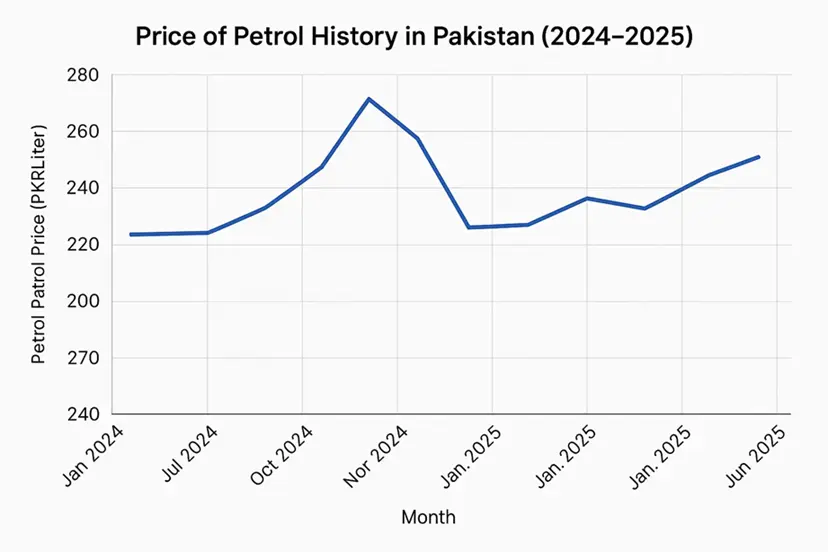
The following table outlines the historical prices of petrol in Pakistan from January 2024 to June 2025:
| Date | Petrol Price (PKR/Litre) |
| June 30, 2025 | 258.43 |
| April 16, 2025 | 254.63 |
| March 29, 2025 | 254.63 |
| March 16, 2025 | 255.63 |
| February 16, 2025 | 256.13 |
| January 31, 2025 | 257.13 |
| January 16, 2025 | 256.13 |
| December 31, 2024 | 252.66 |
| December 16, 2024 | 252.10 |
| December 1, 2024 | 252.10 |
| November 1, 2024 | 248.38 |
| October 16, 2024 | 247.03 |
| October 1, 2024 | 247.03 |
| September 16, 2024 | 249.10 |
| September 1, 2024 | 259.10 |
| August 14, 2024 | 260.96 |
| August 1, 2024 | 269.43 |
| July 15, 2024 | 275.60 |
| July 1, 2024 | 265.61 |
| June 15, 2024 | 258.16 |
| June 1, 2024 | 268.36 |
Source: PakWheels
FAQs
Today, the price of 1 litre of petrol (Super) in Pakistan is PKR 310.71, while High-Speed Diesel (HSD) is PKR 311.47 per litre. Prices are updated based on PSO and government revisions.
The price of 1 litre of fuel in Pakistan varies by product. Petrol is around PKR 310.71, per litre, while diesel is PKR 323.30 per litre. Other fuels, such as LDO and SKO, have separate rates.
According to PSO rates, Premier Euro 5 Petrol is PKR 310.71 per litre, and Hi-Cetane Diesel is PKR 323.30 per litre. Other products include LDO at PKR 244.93 and SKO at PKR 272 per litre.
Currently, 1 litre of petrol costs approximately PKR 310.71, depending on fuel type and station.
The average petrol price in Pakistan is PKR 310.71 per litre, while diesel is slightly lower at PKR 323.30 per litre.
Fuel prices depend on international crude oil prices, the USD-to-PKR exchange rate, taxes, freight charges, and government policy adjustments.
Petrol prices fluctuate due to changes in global oil markets, currency value, and local supply-demand conditions.